
SaaS - Enterprise for SambaNova
How a first-time product designer at a $5.1B AI hardware company built a no-code platform to make enterprise machine learning accessible beyond expert data scientists.
AI / ML
Product Design
The Starting Point
SambaNova had raised $676M but lacked design culture, software products, and intuitive interfaces for its new Machine Learning platform.
Building Enterprise Software from Zero
SambaNova is working to create an AI platform for businesses. The company targets companies that want to integrate sophisticated AI systems into their business yet lack the resources to develop and maintain in-house Data Science teams.
It was April 2021, and after raising $676M and four years of uninterrupted growth, SambaNova Systems decided it was time to expand its offer beyond hardware, creating its first software to run Machine Learning experiments, as even with this funding round, their runway had an expiration date due to the extensive enterprise hardware sale cycles.
The company had world-class engineering talent but had never shipped software, and running Machine Learning training was only accessible via command-line (CLI) to a few thousand experts.
In October 2021, I was recruited by SambaNova Systems as the company's first product designer at a $5.1B valuation.
The mandate: build enterprise SaaS software from scratch, to expand the company's hardware offer, from thousands to millions.

I started from zero in terms of Artificial Intelligence or Machine Learning knowledge. So for weeks I just watched Data Scientists work.
The research was divided into stages, using different methods, and targeted people in critical positions across different layers from a user-operational and business standpoint. I embarked on the task of validating and aligning every stakeholder defining what success may look like around a shared Product Design Strategy Map.

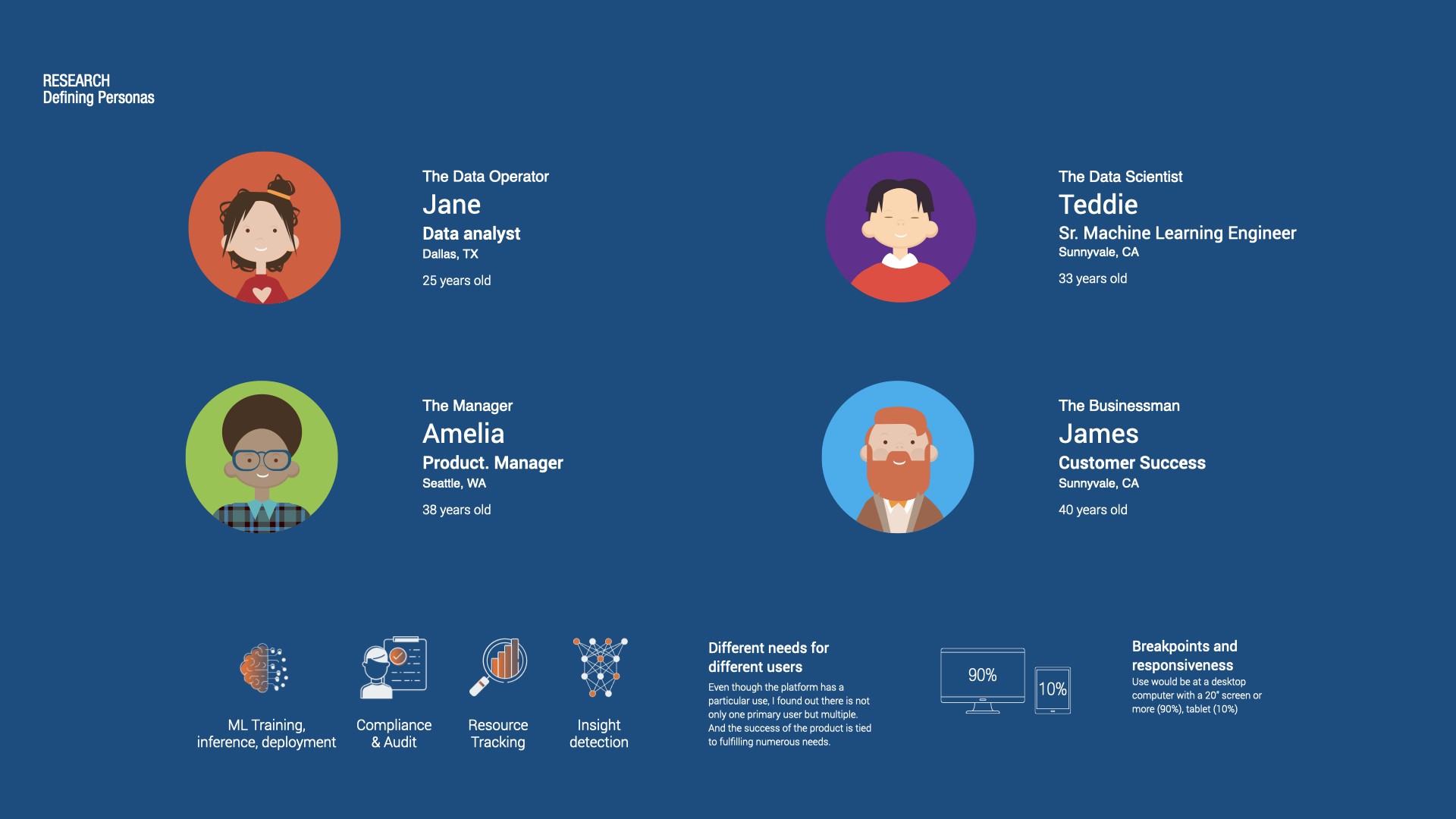
From the company and product go-to-market strategies, target market and verticals, to the final users, I worked to understand first how each layer of information should impact the product, and at which level. I also ran competitive analysis, and defined end-user needs through persona creation.

Building the Foundation
SambaNova’s first design system, created from scratch, standardized development across 40+ components.
From the interviews with the C-Suite, I learned that there would be other products and projects that would require UI. With that in mind, I decided to create a Design System with Master Components to standardize screen development, ensure cohesiveness across products, and speed up the process. The Company's GTM strategy was to project a unique look and feel for every asset, and my task was to balance that visual style at the product level by incorporating the company's visual style into these products. The critical part was to define which elements from the Branding Guidelines could be applied and which required a product design approach, such as font and color palette application.
I created this Design System in Figma that covered five core layers:
• Foundations: Color tokens mapped to both brand and functional states (error, warning, success, neutral), typography scale using Roboto and Roboto Mono, spacing and grid rules for data-dense enterprise layouts
• Components: 40+ master components including buttons, inputs, dropdowns, selectors, tables, cards, and data visualization elements, each with dark mode variants and interactive states
• Patterns: Reusable screen templates for the three core ML workflow stages (configuration, execution, results), reducing design-to-engineering handoff time significantly
• Documentation: Specifications and usage rules written for both junior designers and front-end engineers, enabling the team to build new screens without my direct involvement.
As the team grew, I hired and onboarded two junior designers, establishing the design system documentation and component guidelines as their primary onboarding resource, enabling them to contribute to new screens independently within their first two weeks.
• Governance: Defined which brand elements from SambaNova's marketing guidelines could carry into product UI and which required product-specific interpretation, a critical alignment decision that prevented visual inconsistency across channels
The system became the foundation for SambaStudio and every subsequent product SambaNova built, providing the engineering team with a reliable source of truth from the first commit to launch.
I built seamless experiences almost without supervision, with only a final design QA review.

The pushback and the solution
More that a couple of times I needed to step back in order to be able to move forward.
When I joined SambaNova Systems, they had created some very early-stage flows, UI, and UX. After my research, I found out that the proposed wizard-stepper flow didn't fulfill the users expectations for flexibility when selecting a Data Set, Model and a task. So before even thinking about building any screen I had to push back and go back the the whiteboard phase.
I defined experience maps, low-fidelity artifacts, and the initial workflow, which data scientists validated through card-sorting research to confirm their working methods.
The key insight from testing was that terminology mattered as much as layout; ML-specific language needed to feel native, not translated. The findings validated some of the assumptions, the flows, and the Information Architecture required a full restructuring.
I designed SambaStudio around three core workflow stages: configuration, execution, and results, each mapped directly to how data scientists structure their work in terminal environments.


Results & Launch
SambaStudio shipped in February 2023 with an estimated 70% reduction in workflow complexity.
14 months after my first day, SambaStudio launched with zero prior design precedent inside the company.
Usability testing with internal stakeholders confirmed non-expert users could complete core ML tasks unsupervised after a brief orientation - roughly 70% less time and complexity than the CLI workflow it replaced.
The solution replicated CLI workflows visually across three stages: configuration, execution, and results.The solution replicated CLI workflows visually across three stages: configuration, execution, and results.

FAQ

